Before I begin, I must remind readers that I am a hospital chaplain and worked as a hospital chaplain through the duration of the COVID-19 pandemic.
I woke up with a severe emotional hangover. As the warm shower water rained down my body, I knew the results of yesterday’s excess was worth the morning’s fatigue, body aches, and throbbing headache.
For the past few months, my mind consistently drifted back to a very specific moment in time during the height of the pandemic. The intrusive memory began with a song called Oh My Soul by Casting Crowns.
Oh, my soul
Oh, how you worry
Oh, how you’re weary, from fearing you lost control
This was the one thing, you didn’t see coming
And no one would blame you, though
If you cried in private
If you tried to hide it away, so no one knows
No one will see, if you stop believing
I see the scene clearly.
Summer afternoon.
August to be exact.
August in Texas.
I sat on the floor with my back leaning against the couch and my notebooks opened on the coffee table. I intended to begin a self-guided workbook suggested by my therapist. Something in the study immediately triggered panic and I closed the book never to open it again.
I wept.
Feeling more isolated and alone – and scared – than I ever remember feeling before.
That is the moment she showed up. She sat on the couch but as soon as the room grew dark (even though the sun shone brightly through the windows), she slid to the ground and held me as I cried.
I heaved, fighting for every breath.
I confessed my deepest fears to her.
Working as a chaplain in a hospital at a time when COVID-positive patients occupied all 200+ beds and knowing that anyone who had to be intubated would likely die, I had seen things and heard things that I would never be able to unsee or unhear.
To make matters worse, the political climate caused an unmendable division between me and others removed from the theater of my war. I kept myself safe by shutting myself off from the opinions of the world “out there.”
My therapist offered incredible insight into the dual climate between “us and them.” Termed COVID-PTSD, she likened my experience to a soldier returning home from war – more specifically, like soldiers returning home from Vietnam. (Which explains why Kristin Hannah’s book, The Women, resonated with me when I read it years later.)
Like a lot of veterans of war, I felt safe in the familiar of the battlefield. I felt needed and whole and useful and understood only while at work. I knew my place. Outside of the “safety” of the hospital, I felt unseen, lost, misunderstood, forgotten – hated.
I wept in her arms, gasping out my recognition that the job changed me. I confessed my fear that I would never be who I once was before the pandemic and that if I never got better, she would stop loving me and ultimately end up leaving me.
She agreed that I never would be the same. I couldn’t be and I should never expect to be. Then, she held me tighter to her breast and assured me that I would get better, that one day, I would look back and this would all be a memory. I would not be who I once was, but I would be okay. I will feel safe again. I will be happy again. One day, without even thinking about it, I would laugh and smile and mean it. I would not have to force it or fake it.
Then she added that, even if I never got better, she would never stop loving me. She would never leave me.
After giving me these assurances, we sat there – together – and she held me until my tears dried, my breathing regulated, and I felt safe enough for her to let me go.
Another Casting Crown song, Just Be Held plays in my head:
Stop holding on and just be held.
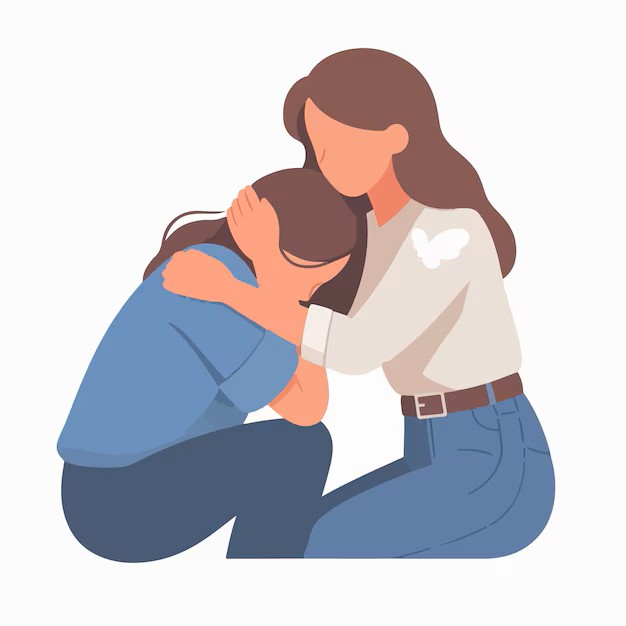
The next time I met with my therapist, I confessed this incident to her. “The thing is,” I whispered, “she isn’t real.”
Rather than the surprise I expected, my therapist simply replied, “She is your coping strategy. She protected you the way your imaginary entourage protected you as a child. You needed her and she came.”
She offered a few insights to consider:
1 – She was my subconscious rising to the surface, giving voice to what I already knew in a way I could understand.
2 – My therapist reminded me of my trips to the Abbey of Gethsemane and how Jesus often came to me in different forms, once looking like the post-war character (with legs) played by Gary Senese in the movie Forrest Gump. Maybe this was Jesus coming to me in the form I needed the most at that moment.
Whatever her identity or purpose, in time, her words proved true. I never returned to the post-COVID version of myself and I am glad for that. Those scars made me a better chaplain and opened the doors for other ministry opportunities that never would have happened otherwise.
I did get better, though, and before I knew it, I smiled and laughed naturally – and often.
I even forgot all about that incident for many years – until the memory recently resurfaced.
Why?
I have many memories that are too painful to dredge up. Whenever they show up, I force them back into that box and shove them back into the furthest corner of my mind. I cannot talk about them, not even with my therapist. I cannot even think or write about them. So why is it that this memory refused to return to its hiding place?
My therapist says that when a memory resurfaces, there is a reason. My subconscious or my body is trying to communicate with me. She has taught me to pay attention—to my thoughts, to the signals in my body, to when they surface, and to what I am doing when they appear.
I tried and thought I had figured it out.
Back then, I felt so completely isolated and alone, but in truth, I was surrounded by love.
I lived with my dad during those early COVID years. He taught me what true love in action looks like and how it feels.
Whenever I got home from work, he stopped whatever he was doing and gave me his undivided attention. If reading a book, he didn’t merely hold his place with his finger. He put the bookmark in, closed the book, and put it on the table. If watching a show, he didn’t simply divert his gaze or mute the television. He turned it off and set the remote on the table. I don’t remember him saying anything in reply. All I remember is that he was there, willing and ready to hear anything I wanted or needed to share about my day.
I had my professors and classmates at Nazarene Theological Seminary. They gave me the space and freedom to tell my story – no judgment, no opinions.
When I almost gave up on organized religion and wanted to walk away from the church and everything that I once held sacred, I attended a pastor’s conference in Nashville and saw several people I used to go to church with at Nashville First Church of the Nazarene. Pastor Ulmet and Dr. Parrott and several others let me tell my story and simply listened. Their support and encouragement reminded me why I joined the Nazarene denomination all those years ago. They gave me hope for a better tomorrow. They continued to be there for me even though I now lived 900 miles away.
Not only did I have an imaginary friend to carry me through my most vulnerable moment, but I had real family and friends who loved me and were willing to listen to my story.
I should never again say “no one” when the fact of the matter is that others still cared about me and for me.
Coming to this realization did not stop this intrusive memory from crawling out of its hiding place.
I let that memory linger and play inside my mind because I didn’t know what else to do with it.
Then came the incident which caused the emotional hangover the following day.
I attended an online meeting with fellow chaplains from the organization that granted my board certification. The gathering, part of a research study about the challenges and resiliency for healthy chaplains, turned into an impromptu group therapy session.
A dozen or so chaplains from across the country—each with different specialties—shared our COVID‑era trauma stories and what carried us through those dark days. The researchers also asked us to describe lingering scars and effects of the new COVID dynamic (i.e. the effects, if any, of the country’s new politically charged climate).
What felt most profound was how, as each person spoke, the rest of us instinctively nodded along, recognizing our own experience in their words. It felt like hearing our own stories echoed back a dozen times.
Finally, the researchers asked us to give one or two sentence descriptions of strategies that sustained us then and strategies that could help in the future. Even though our coping techniques differed somewhat, we all agreed, without exception, that support groups like this would be invaluable going forward.
One participant pointed out that even though we shared a trauma-bond with other hospital staff, the unique role of chaplains created a divide between our experiences and theirs. To have a safe space to share with other like-minded individuals who know what we walked through – who understand what we do and what we did – makes all the difference in the world.
I failed to see the correlation before, but after this session, I realized that what COVID-era chaplains such as myself needed is something that already exists in other settings.
That is why Alcoholics Anonymous exists.
That is why I often refer patients who have lost a loved one to programs like Grief Share.
No one can understand better than someone who is or who has walked the same path.
Why did this never occur to me before?
As my therapist described when she first explained to me how my trauma mirrored that of a soldier returning home from war, each branch of the military is different. All branches may fight in the same war, but their experiences differ, which means that their scars will differ. Only those still within our “shrinking circle” can really appreciate the depth of what we’ve been through.
As each chaplain shared, it became clear that recalling those memories was as painful for the others as it was for me. The weight of it stayed with me the rest of the day.
Lying in bed that night, I attempted to slip into my normal routine – reading a few chapters of Scripture, followed by a few pages from a novel. On this night, I opened the Bible, but the words on the page blurred.
And I began to weep.
Not in pain – certainly nothing like the girl from that vivid memory.
Rather, the tears were a release.
Understanding.
Freedom.
In that moment, I finally understood what I had only sensed on that dark day before my imaginary friend appeared.
I had been right – I was alone.
As I mentioned earlier, even though I was surrounded by people who loved me and cared for me, I still felt profoundly alone. None of them had witnessed what I had or carried the same tormenting memories. Their love was real, and they offered it generously, but I needed something beyond what they could give.
I needed to be seen – scars bare and raw.
After an hour with this group, I got what my heart had been unwittingly aching for all these years.
I realized that I was not and am not an island.
They saw me because they saw it, too.
I once heard a sermon illustration about a little girl who told her mom that she wished she could see Jesus. Her mom assured her that Jesus is always with her. The little girl said she knew that, but she sometimes wished she could see Jesus with skin on.
Sometimes we just need skin on it – whatever our it may be.
Most of the chaplains I know who worked through COVID either brushed it off, treating it like any ordinary season, or avoided the subject entirely. It left me feeling different, as though I were an island standing alone in this chaplain community.
Within this research focus group, highly experienced and self-assured chaplains demonstrated remarkable vulnerability by revealing and owning their emotional scars.
I got to be a part of that.
For me, these colleagues represented both my imaginary friend and Jesus with skin on . . . and for that I am eternally grateful.
Oh, my soul, you’re not alone.
 TRA.Perspective
Leave a comment